Poker is unique among popular games because it is a contest played in the fog of war. In a game like chess, every piece is visible and every possible move can be calculated with total certainty. Poker, however, is a game of incomplete information. You are forced to make high-stakes decisions based on what you cannot see.
The Hidden Variable Problem
In poker, the most important piece of data is the one you don't have: the two cards in your opponent's hand. Beginners often find this unbearable. They try to "put their opponent on a hand," often picking one specific combination like "He has Ace-King."
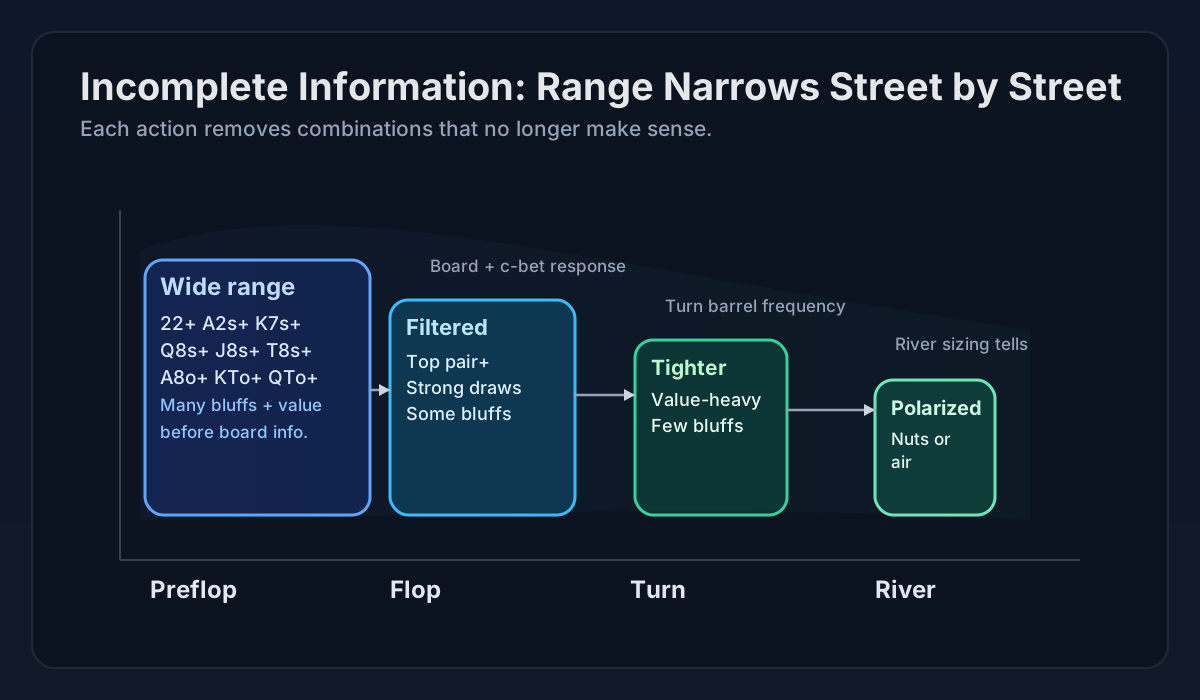
This is a mistake. Because information is incomplete, you must think in ranges. You aren't trying to guess the exact cards. You are calculating the probability of an entire distribution of cards. This shift from "guessing" to "probabilistic mapping" is the moment a player moves from amateur to student.

The Process-Oriented Mindset
Because information is incomplete, the connection between a "good move" and a "good result" is broken. You can play a hand perfectly, get your money in as an 80% favorite, and still lose the pot. In any other field, a bad result usually means a bad decision. In poker, that logic will destroy your mental game.
Mastering the unseen means falling in love with the process. You must reach a point where you feel satisfied with a loss if you know the math was in your favor. This is why practicing against our bots at EasyPokerPlay is so effective. You can see the logic of the bot, review your decision, and realize that even when the chips went the other way, your thinking was sound.
Bayesian Updating in Real Time
As a hand progresses, the "unseen" becomes slightly clearer. Every check, every sizing, and every second spent thinking is a piece of information. You use this to update your mental model of the opponent's range. This is called Bayesian updating.
The Cost of Certainty
Many players lose money because they "pay to see it." They cannot handle the discomfort of the unknown, so they call a large river bet just to satisfy their curiosity. In an incomplete information game, curiosity is expensive. You must learn to be comfortable making a fold based on the evidence, even if you never get to see the cards.
Wrapping Up
Poker is a beautiful, frustrating exercise in decision-making under pressure. By accepting that you will never have all the data, you free yourself to focus on what you can control: your logic, your emotional discipline, and your commitment to the process. Use the free tables at EasyPokerPlay to refine your "range-reading" muscles until the unknown no longer feels like a threat.