When the flop hits the table, most beginners look at their own hand and think "did I hit?" That is only half the equation. The community cards tell a story about every player in the hand, not just you. Learning to read the board is what separates a reactive player from a strategic one.
Board texture refers to how the community cards relate to each other and to the likely ranges of hands in play. Is the board coordinated or scattered? Are there draw possibilities or is it completely locked down? These questions shape every decision you make on the flop, turn, and river.
The Two Extremes: Dry vs Wet
Dry Boards
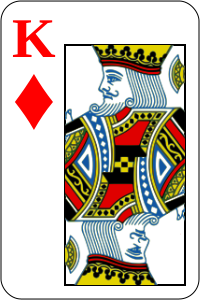
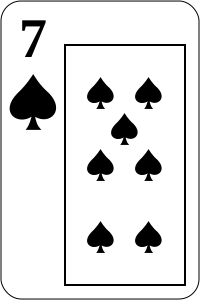
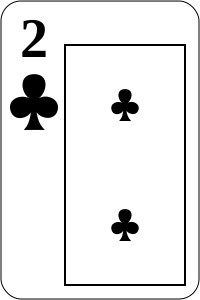
On this board, there are no flush draws (three different suits), no straight draws worth mentioning, and the cards are spread far apart. If you raised preflop and your opponent called, this is a board where your range is heavily favored. You likely have more Kings, more strong pocket pairs, and more big card combinations. Your opponent's range (calls with speculative hands, suited connectors, small pairs) mostly missed.
On dry boards, continuation bets succeed at a very high rate. You can often use a smaller sizing because opponents will fold regardless. There is little reason to bet big since there are no draws to charge.
Wet Boards
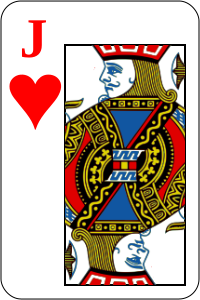
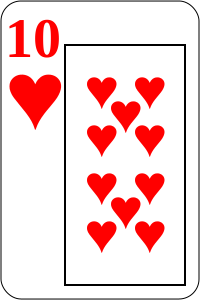
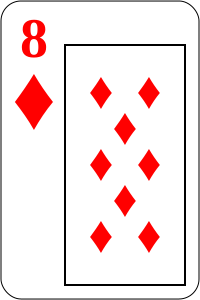
This is the opposite extreme. There is a flush draw in hearts, multiple straight draws (9-7, Q-9, K-Q, 7-6), and the cards are closely connected. Both your range and your opponent's range connect heavily with this board. Suited connectors, big broadway cards, and medium pairs all have pieces here.
On wet boards, bluffing becomes much harder because opponents have reason to continue. If you bet, expect to get called or raised more frequently. When you do bet, use a larger sizing to deny draws the correct odds to chase.
The Three Key Factors
Every time you see a flop, quickly scan for these three things. Together, they tell you how "dangerous" the board is.
1. Connectedness
How close are the cards in rank? A flop of J-T-9 is extremely connected. Everyone who plays broadways or suited connectors has a piece. A flop of K-7-2 has massive gaps and very few holdings connect with all three cards.
2. Suits
A "rainbow" flop (three different suits) kills flush draws entirely. A "two-tone" flop (two of one suit) opens one flush draw. A "monotone" flop (all same suit) means anyone with two cards of that suit already has a flush, and anyone with one card has a draw.
| Suit Pattern | Name | Flush Draw Risk |
|---|---|---|
| 3 different suits | Rainbow | None |
| 2 of one suit | Two-tone | One flush draw possible |
| 3 of one suit | Monotone | Flush already possible, many draws |
3. High Card Presence
Boards with an Ace are very different from boards without one. When an Ace lands on the flop, the preflop raiser's range benefits enormously because they have far more hands containing Aces (AK, AQ, AJ, AT). Low card boards like 7-4-2 tend to favor the caller's range more, since their speculative hands (small pairs, suited connectors) interact better with low cards.
Board Texture and Range Advantage
The concept of range advantage ties directly to board texture. Whoever's range interacts better with the flop has the strategic edge. This does not mean they have the best hand every time. It means that on average, across all the hands they could hold, they benefit more from these specific community cards.
How the Board Changes on the Turn and River
Board texture is not a one-time assessment. The turn and river can transform a dry board into a dangerous one. A flop of K♠ 7♠ 2♣ is relatively dry, but if the turn brings the 8♠, suddenly there is a completed flush for anyone holding two spades, plus open-ended straight draws become possible.
Reassess the texture on every new street. A hand that was clearly the best on the flop might need to slow down if the turn or river brings a card that completes obvious draws.
Practical Board Reading Drill
Here is a quick exercise you can do during any session. When the flop is dealt, immediately classify it before you think about your own hand:
- Is it dry, wet, or somewhere in between?
- Are there flush draws?
- Are there straight draws? How many?
- Does this board favor the raiser or the caller?
With practice, this scan becomes automatic and takes less than a second. You can sharpen this skill quickly by playing hands against bots on EasyPokerPlay, where you can focus on reading the board without the stress of risking real chips.
Wrapping Up
Board texture is the lens through which every post-flop decision should be filtered. Dry boards let you bet small and often. Wet boards require caution and bigger sizing. High cards favor the raiser, low cards favor the caller. Train yourself to read the board first, and the rest of your strategy will fall into place.