When beginners watch a poker hand play out, they try to guess the exact two cards their opponent holds. "He probably has Ace-King." This is a natural instinct, but it is fundamentally wrong. No matter how many tells you pick up or how well you read the situation, you can never know the exact hand someone is holding until showdown.
Strong players do not put their opponent on a single hand. They put them on a range. This shift in thinking is the single biggest leap a player can make on the journey from beginner to intermediate.
What is a Range?
When your opponent raises from early position, they could have AA, KK, QQ, AK, AQ, JJ, and a handful of other strong hands. When they call a raise from the big blind, they could have suited connectors, small pairs, broadway cards, and occasionally traps like AA or KK. Each action narrows the range, but it never narrows it to one hand.
Why Single Hand Reads Fail
The problem with guessing a specific hand is that it leads to binary thinking. "He has AK, so I fold" or "He has a bluff, so I call." But what if you are wrong? You have no backup plan.
Range thinking replaces that guess with a probability distribution. Instead of "he has AK," you think "his range includes AK, KQ, QQ, JTs, and some bluffs. Against that range, my top pair is ahead roughly 65% of the time. I should call."
Constructing an Opponent's Range
Building a range starts before the flop and narrows on every street. Each action your opponent takes eliminates some hands and keeps others. Here is how to work through it.
Step 1: The Preflop Range
Think about what position your opponent is in and what action they took. A player who raises from UTG has a much narrower range than someone who calls from the button.
Step 2: Narrow on the Flop
When the flop is dealt, ask yourself: which hands in their preflop range would take this action on this specific board? If they bet on an Ace-high flop, hands without an Ace become less likely (though not impossible as bluffs). If they check, strong top-pair hands become less likely.
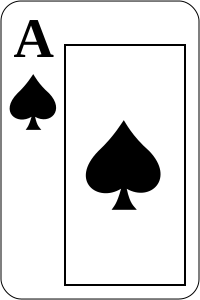
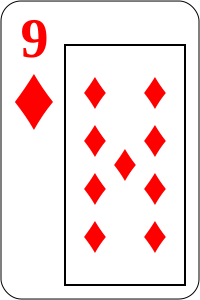
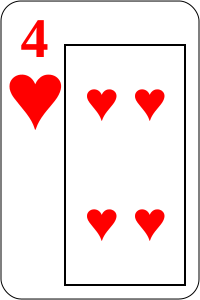
Your opponent raised from the hijack and you called from the big blind. They bet on this flop. Their range now heavily weights toward Ace-x hands (AK, AQ, AJ, AT), overpairs (KK, QQ), and some bluffs with backdoor draws. Hands like 87s or 65s that were in their preflop range are less likely to bet here.
Step 3: Continue Narrowing
Every street adds another filter. By the river, your opponent's range might be narrowed down to a dozen or fewer hand combinations. You still do not know which one they have, but you know the relative proportions of strong hands, medium hands, and bluffs.
Ranges and Your Own Hand
Range thinking is not just for reading opponents. It applies to your own game too. When you bet, you should think about what your entire betting range looks like, not just the hand you currently hold.
If you only bet the flop with strong made hands, your checking range becomes full of weak holdings. An observant opponent will attack your checks because they know you have nothing. By including some bluffs in your betting range and some strong hands in your checking range, you become much harder to play against.
Counting Combinations
To think in ranges effectively, it helps to understand how many ways a hand can be dealt. This is called combinatorics.
| Hand Type | Combinations | Example |
|---|---|---|
| Pocket pair | 6 | AA can be dealt 6 ways (A♠A♥, A♠A♦, A♠A♣, A♥A♦, A♥A♣, A♦A♣) |
| Suited hand | 4 | AKs: one for each suit |
| Offsuit hand | 12 | AKo: 4 Aces x 4 Kings minus 4 suited = 12 |
When a card appears on the board, it removes combinations. If an Ace is on the flop, there are only 3 remaining Aces in the deck. This means AA goes from 6 combos down to 3, and AK suited goes from 4 combos down to 3. These numbers matter when you are estimating how likely your opponent is to have a specific holding.
Putting It Into Practice
Range thinking is a muscle. It takes repetition to build. Here is a simple drill you can do during any session, especially while practicing on EasyPokerPlay:
- Before every decision, write down (mentally or physically) three to five hands your opponent could have.
- After each street, cross off hands that no longer make sense given their action.
- By the river, see how narrow the range has become.
- At showdown, check if their actual hand was in your estimated range.
Over time, this process becomes automatic. You will stop guessing specific hands and start thinking in terms of ranges without conscious effort.
Wrapping Up
Thinking in ranges transforms poker from a guessing game into a logical puzzle. You stop asking "what does he have?" and start asking "what could he have, and how does my hand perform against all of those possibilities?" This shift in perspective is the bridge between playing poker and understanding it.