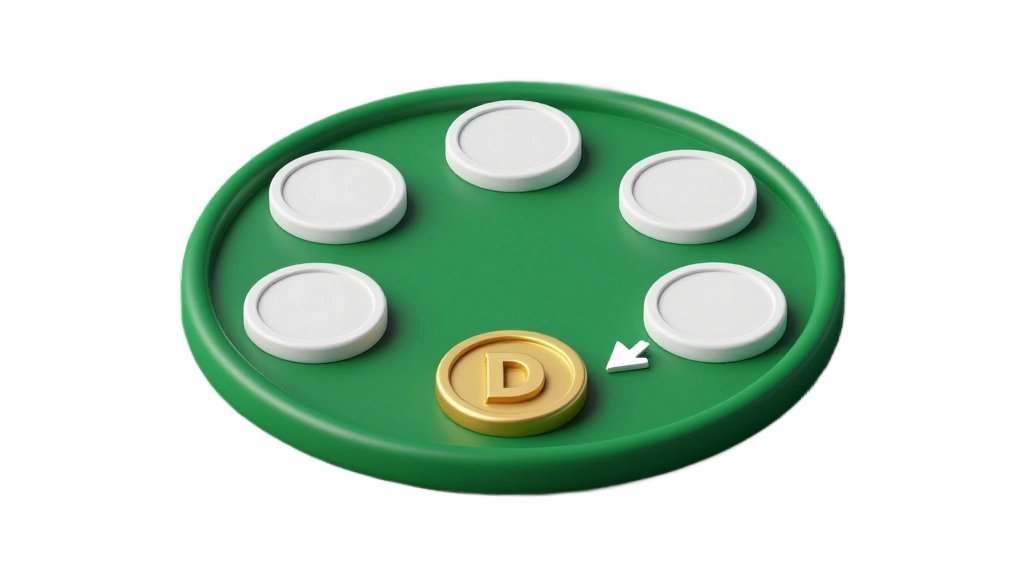
If you ask successful poker players what the most important factor in a hand is, they won’t say "my cards." They will say "my position."
In Texas Hold’em, your seat at the table determines when it is your turn to act. Because the action moves clockwise, some players get to see what everyone else does before they have to make a decision. We call this the Information Advantage, and it is the secret to winning more chips with worse cards.
What is "Position"?
Think of it like a game of hide and seek. If you know exactly where everyone else is hiding before you have to move, your job is much easier. In poker, if you see three people check in front of you, you know they likely have weak hands, and we can use that information to take the pot.
The 9-Player Table Map
We divide a standard nine-player table into four main groups. In the diagram below, the positions are evenly distributed along the table axis, starting with the Button at the far left.
The Four Position Groups
| Group | Seats included | Action Order |
|---|---|---|
| Early (EP) | Under the Gun (UTG), UTG+1, UTG+2 | Acts first preflop; mid-order postflop |
| Middle (MP) | Lowjack (LJ), Hijack (HJ) | Acts after Early position |
| Late (LP) | Cutoff (CO), Button (BTN) | Acts last in the round (Most Advantage) |
| The Blinds | Small Blind (SB), Big Blind (BB) | Acts last preflop; First postflop (Worst) |
1. Early Position: Under the Gun (UTG)
Players in UTG, UTG+1, and UTG+2 are in a difficult spot. They have to act first pre-flop with no information about the seven players behind them. Because the risk of someone behind you having a "monster" hand is high, we must play very "tight" (only strongest cards) from these seats.
2. Middle Position: Lowjack (LJ) & Hijack (HJ)
In the Lowjack and Hijack seats, we are in the transition zone. Some players have folded in front of us, making it slightly safer to enter the pot. We can start opening more hands here than in UTG, but we still have several dangerous players in Late position and the Blinds left to act.
3. Late Position: The Power Seats
The Button (BTN) is the absolute best seat in the game. Post-flop, the button is always the last person to act. This means we have total information on every opponent's action before we decide to bet or check. The Cutoff (CO) is the second-best seat, inheriting the power of the button if the player on the button folds.
4. The Blinds: High Risk, Lower Cost
The Small Blind (SB) and Big Blind (BB) act last before the flop, but they must act first on every round after that. This makes them a "post-flop nightmare" because we are forced to act without knowing what anyone else will do.
However, because the blinds have already posted forced bets, they have money already sitting in the pot. This means when someone raises, the blinds need to contribute fewer chips than other players to call.
Action Order Comparison
Notice how the advantage shifts once the community cards are dealt:
- Preflop: Action starts with UTG and ends with the Big Blind.
- Post-flop: Action starts with the Small Blind (if they haven't folded) and ends with the Button.
How to Adjust Your Strategy
A common mistake is playing the same cards regardless of the seat. To win, we must adjust our hand selection based on our proximity to the button:
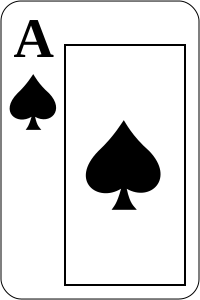
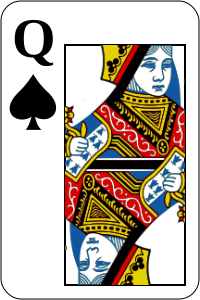
Tight: We only play premium cards here because we have to act first against the whole table.
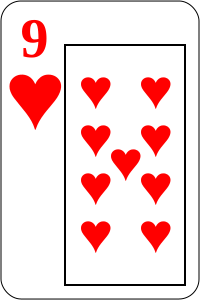
Wide: We can play "speculative" hands like suited connectors because our position allows us to control the pot size if we miss the flop.
Practice Position Dynamics
Understanding position in theory is easy, but feeling its power requires repetition. We suggest using the Practice mode on EasyPokerPlay.
In Practice mode, you can set specific table scenarios, such as always being on the Button or always being in the Small Blind to see exactly how much easier it is to win when you have the information advantage.
Wrapping up
Once we start respecting position, we find ourselves in fewer "tough spots" and more "profitable spots." Before you play your next hand, take a look at the dealer button and ask: "Who has the information advantage here?"