Many beginners believe poker is a game of "gut feelings" or "reading souls." While psychology is part of the game, the foundation of winning poker is simple mathematics.
The most important math concept to master is Pot Odds. This is the relationship between the size of the pot and the size of the bet you are facing. Understanding this tells us exactly how often we need to win the hand to make a "Call" profitable in the long run.
What are Pot Odds?
The Basic Calculation
Imagine there is $100 in the pot. Your opponent bets $50. The pot is now $150. It costs you $50 to call.
We can express this in two ways:
- As a Ratio: 150 to 50 (which simplifies to 3:1).
- As a Percentage: How much of the total final pot are we contributing?
Converting Odds to Percentages
To make a decision, we need to know the "break-even" percentage. This is the formula we use:
Using our example: $50 / ($150 + $50) = 25%
This means if we think our hand will win more than 25% of the time, calling is a profitable decision. If we win less than 25%, we should fold.
Common Pot Odds Scenarios
| Opponent's Bet Size | Pot Odds (Ratio) | Win % Needed |
|---|---|---|
| Full Pot ($100 into $100) | 2:1 | 33% |
| Half Pot ($50 into $100) | 3:1 | 25% |
| Quarter Pot ($25 into $100) | 5:1 | 17% |
The Relationship with "Outs"
Knowing you need 25% to call is only half the battle. You also need to know how likely your hand is to improve. We do this by counting "Outs"—the cards left in the deck that will give us the best hand.
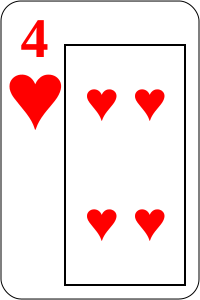
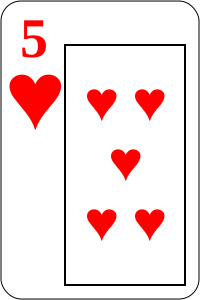
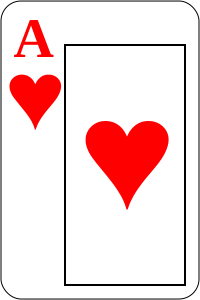
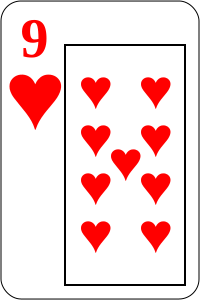
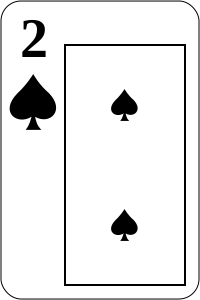
In this example, we have a Flush Draw. There are 13 hearts in the deck. We see 4 of them (2 in our hand, 2 on the board). That means there are 9 hearts (outs) left that can give us a Flush.
9 outs x 4 = ~36% chance to hit your flush by the river.
Putting it Together: The Profitable Call
Now we compare the two numbers:
- Pot Odds Needed: 25% (based on the bet size).
- Actual Chance of Winning: 36% (based on our flush draw).
Since 36% is greater than 25%, this is a mathematically profitable call. Even if we lose this specific hand, we will make money in the long run by making this call every time.
How to Practice the Math
Doing these calculations in your head under time pressure can be challenging. Experienced players, however, tend to process them automatically thanks to the large number of hands they’ve played. We recommend trying our Practice Mode on EasyPokerPlay to build volume.
Summary Checklist
- Calculate the Total Pot: Add the current pot + the opponent's bet.
- Calculate the Call Cost: How much you need to put in.
- Find the % Needed: Call / (Total Pot + Call).
- Estimate Your Equity: Count your outs and use the Rule of 2 and 4.
- Compare: If Equity > % Needed, we Call. Otherwise, we Fold.
Wrapping up
Pot odds turn poker from a game of chance into a game of skill. When we stop guessing and start calculating, the "luck" factor begins to disappear. Before we make our next call, we should always ask: "Is the pot giving me the right price?"