
You raised preflop, got one caller, and now the flop is on the table. What do you do? Most of the time, you should bet. This is called a continuation bet (or c-bet), and it is one of the most powerful weapons in a poker player's arsenal.
The c-bet works because the player who raised before the flop is assumed to have the stronger range. Opponents know this, and they fold a lot of hands that missed the board. Understanding when to fire, how much to bet, and when to pump the brakes is the difference between printing chips and burning them.
What is a Continuation Bet?
The name says it all. You raised before the flop to represent a strong hand. The flop arrives, and you continue telling that story with a bet. Even when you miss the board, a well-timed c-bet can take down the pot without resistance.
Why the C-Bet Works
Here is a fact that surprises most beginners: the flop misses both players roughly two-thirds of the time. When your opponent calls your preflop raise, they will whiff the board the majority of flops. If you bet and they have nothing, they fold. Simple as that.
When to C-Bet
Not every flop is a good candidate for a continuation bet. The two most important factors are the board texture and the number of opponents.
Dry, Disconnected Boards
These are the best flops for c-betting. When the board has no draws and cards that likely missed your opponent's calling range, a bet takes it down at a very high frequency.
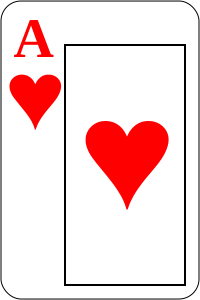
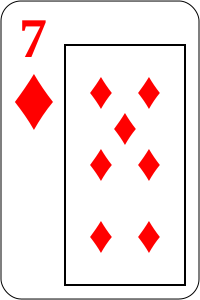
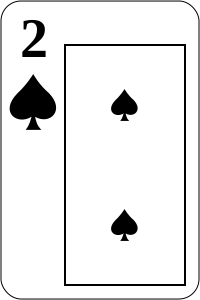
On a board like this, your preflop raising range contains many Aces while your opponent's calling range has far fewer. You have what is called a range advantage, and betting is almost always correct.
Wet, Connected Boards
When the board has flush draws, straight draws, or both, you need to be more selective. Your opponent is more likely to have connected with these flops, and a c-bet will get called or raised more often.
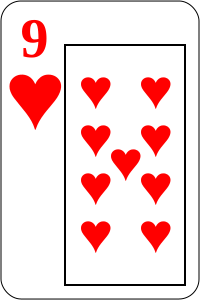
Number of Opponents
The c-bet is most effective heads-up (against one opponent). The more players in the pot, the more likely someone has connected with the board. Against three or more opponents, you should almost never c-bet without a real hand.
| Opponents in Pot | C-Bet Frequency | Reasoning |
|---|---|---|
| 1 (heads-up) | High (60-70%) | One player to get through, likely missed |
| 2 | Moderate (35-50%) | Harder to bluff two players off the pot |
| 3+ | Low (value only) | Someone almost always has a piece |
How to Size Your C-Bet
Sizing is one of the most misunderstood parts of continuation betting. Many players default to half-pot or two-thirds pot on every flop without thinking about why. The right size depends on what you are trying to accomplish.
Small Sizing (25-33% pot)
Use smaller bets on dry boards where your range advantage is clear. You do not need to bet big because your opponent is folding most of their air regardless. The small bet risks less when you are bluffing and still extracts value when you have it.
Medium Sizing (50-66% pot)
This is the default for most flops. It puts enough pressure on draws and marginal hands while keeping the pot manageable.
Large Sizing (75-100% pot)
Reserve bigger bets for wet boards where you hold a strong hand and want to charge draws the maximum price. If the flop has multiple draw possibilities, a larger sizing denies your opponent the correct pot odds to continue.
When to Skip the C-Bet
Knowing when NOT to c-bet is just as important. Here are three common spots where checking is often better than betting.
- You have nothing on a wet board. Bluffing into a board like J♣ T♣ 8♦ with a hand like A♠ 3♠ is asking to get raised. Check and give up.
- Multiple opponents. As mentioned, the more callers you face, the less you should bluff. Check unless you have real equity.
- Your hand benefits from a free card. If you hold a hand like 6♠ 5♠ on a board of 8♠ 4♠ 2♣, you have a flush draw. Checking allows you to see the turn for free and potentially hit a monster.
The Turn Decision: Barrel or Shut Down?
After you c-bet and get called, you face another decision on the turn. This is called the "second barrel," and it requires a good reason. You should fire again if:
- You improved your hand (hit a pair, picked up a draw).
- A scare card arrived that favors your range (like an Ace or King on a low board).
- Your opponent's range is capped (they would have raised strong hands on the flop).
If none of those apply, give up. Firing a second barrel with no plan is how you turn a small, controlled bluff into a big mistake.
Putting It All Together
To practice these concepts with zero risk, try setting up specific flop scenarios on EasyPokerPlay. You can isolate heads-up spots on different board textures and build the pattern recognition that lets you make c-bet decisions instinctively.
Wrapping Up
The continuation bet is your bread-and-butter play as a preflop aggressor. Bet more on dry boards, less on wet ones. Size smaller when your range advantage is huge, and bigger when you need to charge draws. Check when you have no equity and no fold equity. Master this, and you will win more pots with less resistance than ever before.